A serum sells steadily for months, then one video mentions it and the entire batch is gone by morning. That's a good problem for a beauty or skincare brand to have, until the sold-out page shows up with no way for the next wave of interested shoppers to do anything but leave. Beauty merchants are paying more attention to back-in-stock alerts because they keep hitting the same moment: real demand, no way to capture it.
Beauty and skincare restock differently than most categories Shopify merchants sell in, and the notification strategy that works for a predictable reorder cycle doesn't automatically fit a category where the biggest sellout events are the ones nobody saw coming.
Why Beauty and Skincare Restocks Are Different From Other Categories
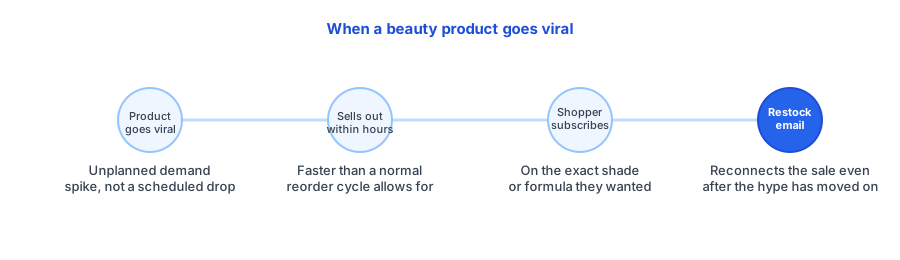
Most restock advice assumes some kind of predictable pattern, a subscription cadence, a seasonal collection, a scheduled drop. Beauty and skincare break that assumption more than almost any other vertical. A cult beauty product sold out event is frequently triggered by something completely outside the merchant's control: an influencer post, a trending video, a roundup article. Demand can spike well beyond what inventory was planned for, with little or no advance warning.
That unpredictability is exactly why a passive "check back later" approach fails here. By the time a merchant notices the spike and reorders, the moment that created the demand has often already passed, but the shoppers who wanted the product during that spike are still out there if there's a way to reach them again.
The Case for a Skincare Restock Notification During a Viral Moment
A skincare restock notification does something a merchant can't do manually at the speed a viral moment demands: it captures every interested shopper the instant they hit the sold-out page, without anyone having to notice the spike is happening in real time. That's the difference between losing a surge of attention entirely and converting a meaningful share of it once inventory catches up, even if that's weeks later.
Shade Discontinuation: A Beauty-Specific Wrinkle
There's a version of the discontinuation problem that's specific to beauty rather than a copy of what happens in other verticals. Makeup shades get retired every season. Limited-edition collections are often designed to never come back on purpose. Packaging redesigns can quietly replace an SKU entirely, so even if the formula continues, the exact product a shopper subscribed to technically won't restock under that listing again.
A back-in-stock alert that fires a false promise on a permanently retired shade does real damage, especially to a shopper who's been checking back. The fix is the same principle used elsewhere but applied to beauty's own version of the problem: know which SKUs are genuinely restockable versus permanently retired, and route the retired ones to a general new-arrivals or restock-adjacent signup instead of a notify-me that will never fire.
See how a shade-aware "Notify Me" widget looks on your beauty or skincare store, free to start.
Install Griffin on ShopifyWhat to Look for in a Shopify Beauty Brand App
A few things matter more for beauty and skincare than they do in steadier categories:
- Shade and size variants tracked separately. A shopper who wanted a specific shade won't reorder just because a different one restocked. Notifications need to match the exact variant someone subscribed to.
- Fast delivery once inventory clears. Viral attention fades quickly, so a restock email that goes out the moment stock updates matters more here than in categories with a longer natural buying window.
- No false restock promises on shades or collections that are genuinely retired rather than temporarily out.
- No theme code editing required, so the widget can go live fast when a spike happens without waiting on developer time.
FAQ
Why do beauty and skincare products sell out so unpredictably?
A single viral moment, like an influencer mention or a trending video, can spike demand for a specific product or shade well beyond what a merchant planned inventory for. Unlike a scheduled drop, there's often no advance warning.
What happens if a shade or formula is discontinued instead of restocked?
A back-in-stock alert shouldn't promise a restock that isn't coming. If a shade is discontinued or a collection is retired, that calls for a different message pointing shoppers to the closest current product, not a vague notify-me that never fires.
Does back-in-stock tracking need to be shade-specific for beauty products?
Yes. Shade, finish, and size are typically separate variants, and a shopper who wanted a specific shade won't reorder just because a different one is back. Notifications should match the exact variant someone subscribed to.
Is it too late to capture a sale if the viral moment has already passed by restock time?
Not usually. A shopper who subscribed to a restock alert has already shown real intent, not just passing interest, so a restock email often still converts well even weeks later, as long as the notification actually goes out the moment inventory clears.
The Bottom Line
Beauty and skincare brands don't get to plan their biggest sellout moments the way a scheduled drop or a subscription reorder cycle does. What they can control is whether a shopper who shows up during that spike has any way to come back once inventory catches up. A shade-aware, fast-firing restock alert turns an unpredictable sellout into a recoverable sale instead of a missed one.
If you're setting this up for the first time, Griffin installs as a lightweight app block with variant-aware notify-me subscriptions, no theme code edits required. For products that genuinely won't be restocked in the same form, it's also worth reading how one-of-a-kind pieces handle the same problem in jewelry for a comparable approach. Install Griffin on the Shopify App Store to get started free.