WhatsApp back-in-stock apps lean on a straightforward pitch: customers already have the app open, so a restock alert lands somewhere they'll actually see it, unlike an inbox competing for attention. For stores whose customers live in markets where WhatsApp genuinely is the default way people communicate, that pitch holds up. What most app listings skip over is that WhatsApp back-in-stock alerts don't work like installing an email widget, they route through a separate platform with its own account, approval process, and cost structure layered on top of whatever the Shopify app itself charges.
What a WhatsApp Back-in-Stock Alert Actually Requires
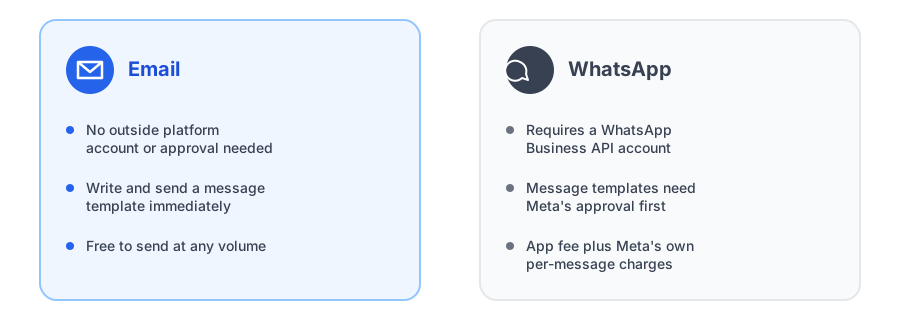
Sending a restock message over WhatsApp isn't a matter of flipping on a toggle inside a Shopify app. It runs through the WhatsApp Business API or Business Platform, a Meta product with its own account setup, entirely separate from the Shopify app connecting to it. The message itself has to be built as a template, and that template needs Meta's approval before it can be sent to a single customer, which is a real review step with its own turnaround time, not something that happens the moment you write the copy.
There's also a dedicated opt-in requirement specific to WhatsApp messaging, distinct from an email signup. A customer agreeing to get store emails hasn't automatically agreed to get messaged on WhatsApp, so a whatsapp notification shopify app needs to collect that consent on its own terms, the same way SMS requires its own separate opt-in rather than inheriting one from email.
The Real Advantage: Reaching Customers Where They Already Are
The genuine strength of this channel depends heavily on where your customers actually are. In a lot of markets outside the US, WhatsApp functions less like an optional messaging app and more like the default line of communication, filling the role email and SMS split domestically. For a store with real traffic from those markets, a back in stock alert channels comparison genuinely tilts toward WhatsApp having reach that email alone doesn't match. For a store whose customers are mostly checking email day to day, that advantage mostly doesn't apply, no matter how appealing "they're already using it" sounds in an app's marketing copy.
See how a reliable, branded restock email looks before adding another platform to manage.
Install Griffin on ShopifyThe Real Cost Structure
An email vs whatsapp restock alert comparison has to account for two separate cost layers on the WhatsApp side, not one. The Shopify app itself carries its own subscription fee, the same as any back-in-stock tool. On top of that, Meta charges its own per-message fees for WhatsApp Business messaging, charges that exist independently of whatever the app costs and scale with how many notifications you actually send. That's the same two-layer structure SMS has, carrier costs stacked on top of an app fee, just with a different platform doing the charging. Email avoids this entirely: there's no outside platform taking a per-message cut, so the app's own price is the whole cost.
Setup Overhead Most Merchants Don't Expect
Getting a WhatsApp Business API account set up, verified, and ready to send approved templates is a heavier lift than installing and configuring an email-first app block. It's a reasonable investment if restock volume and customer concentration in WhatsApp-heavy markets justify it. For a smaller store testing the waters, or one whose customers are elsewhere, that setup time is being spent against a channel that may never carry much real volume.
FAQ
Do I need anything beyond a Shopify app to send WhatsApp back-in-stock alerts?
Yes. You need a WhatsApp Business API or Business Platform account tied to Meta, separate from the Shopify app itself, and your restock message template needs to be approved by Meta before you can send it.
Does WhatsApp back-in-stock messaging cost extra beyond the app subscription?
Yes. Meta charges its own per-message fees on top of whatever the Shopify app itself costs, similar to how SMS carrier costs stack on top of an app's subscription fee.
Is WhatsApp a good fit for every Shopify store?
It's most worth considering for stores with a customer base concentrated in regions where WhatsApp functions as the default personal messaging app. For a store whose customers mostly use email, the setup overhead usually outweighs the reach benefit.
Does Griffin support WhatsApp notifications?
No. Griffin is intentionally email-first, the same reasoning that keeps SMS and web push out of the product: most merchants get the bulk of the value from one reliable, branded channel without the setup and compliance overhead an additional platform brings.
The Bottom Line
WhatsApp back-in-stock alerts earn their appeal honestly for the right store: one with real customer concentration in a market where WhatsApp is the default channel, and enough restock volume to justify a Meta Business API setup and its ongoing per-message cost. Outside of that specific fit, the approval process and second layer of billing are a lot of overhead for a channel most merchants' customers won't actually use.
For the same trade-off applied to SMS, see our email vs SMS back-in-stock alerts comparison. Griffin keeps things simple with one reliable, branded restock email and no extra platform to manage. Install Griffin on the Shopify App Store to see it on your own store, free to start.