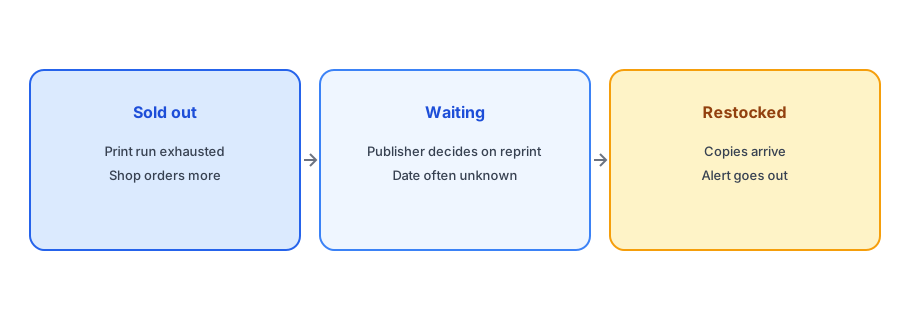
An independent bookshop or stationery store sells goods it does not make. When a title sells out, the shop orders more, and what happens next depends on a publisher or distributor with its own schedule. Sometimes copies arrive in days. Sometimes the title is out of print, awaiting a reprint with no date, or about to be replaced by a new edition. That uncertainty is central to how back-in-stock alerts for books and stationery should work. We could not find reliable published data for this niche, so the post reasons from how books and stationery are supplied and sold, without inventing numbers.
Reprint Dates Are Often Unknown
For a bestselling title the answer may be quick, but for backlist books a publisher may wait until demand justifies another print run. A shop may hear "reprint planned" without a date, or nothing at all. Be honest on the sold-out page: "We have ordered more and expect it within a few weeks" if that is true, or "This title is awaiting a reprint and we do not have a date" if it is not. The second message sounds worse but builds more trust than a guess. Pair it with a Notify Me form so shoppers can be told when copies land. Our replies for "when will it be back in stock?" include wording for uncertain timing.
Editions and Formats Are Variants
A single title may exist as hardcover, paperback and a special edition, each with its own price and stock. On Shopify these are naturally variants, and a shopper waiting for the hardcover does not want to hear that the paperback returned. Griffin ties each signup to the variant chosen and notifies only that variant's subscribers when it is restocked. If a new edition replaces an old one, treat that as a different product, not a restock, and tell subscribers; our guide to handling subscribers when a product is discontinued explains the wording.
Planners and Dated Stationery Have Seasons
Stationery has its own rhythm. Dated planners and calendars sell in a window, and a sold-out planner in December may be worthless in March. For items with a use-by season, an alert is time-sensitive, and a restock after the season ends is better replaced by an honest message. Undated notebooks and pens sell steadily and restock more predictably. Use your sales history to separate the two, and be careful with promises about dated items. The seasonal inventory planner can help you work out how deep to buy.
Tell readers when their title is back. Griffin adds Notify Me to each sold-out format and is free to start.
Install Griffin on ShopifyGift Deadlines and Group Orders
Books and stationery are common gifts, and they are often bought for a date: a birthday, a school term, a holiday. A shopper with a deadline needs an answer fast. Say in the alert whether the order will arrive in time, and include your shipping cutoff near holidays; our guide to holiday stockouts and shipping cutoffs covers it. Schools, clubs and book groups sometimes buy several copies at once, which can empty a small restock quickly. If that matters for a title, consider a per-customer limit and mention it in the email.
Signups as Demand Evidence for Your Distributor
A list of people waiting for a title is useful information. If you stock a book that a publisher is slow to reprint, evidence of local demand helps you decide how many copies to order when they arrive, and may help your conversation with a distributor. Treat counts as hints rather than guarantees, and note that a long list for an out-of-print title is a reason to look for an alternative supplier or a used copy source, if that suits your shop. Our guide to tracking customer demand for out-of-stock products shows how to read signup data.
Writing the Restock Email for a Reader
Lead with the title and format, add the author, and link straight to that edition. If you only received a few copies, say so, so readers understand why you recommend acting soon. A line about whether the book is signed, new or a particular printing helps collectors and gift buyers. Keep the message short, and include your return terms if the book is a gift item. Readers are used to waiting for books, so a calm, accurate email works better than urgency.
A Practical Checklist
- Add Notify Me to every format and edition that can sell out.
- Be honest when the reprint date is unknown.
- Treat a new edition as a new product and tell subscribers.
- Separate dated stationery from evergreen items in your wording.
- Mention shipping cutoffs and quantity limits when relevant.
- Use signup counts to decide how many copies to order.
FAQ
Why do bookshops need restock alerts?
Because titles sell out and return on a publisher's schedule. An alert tells readers when copies arrive without them checking repeatedly.
What if I do not know the reprint date?
Say so plainly and offer Notify Me, so the shopper is told when the book is back instead of waiting on a guess.
Should hardcover and paperback have separate alerts?
Yes. Each format is a variant with its own stock, and subscribers should hear only about the one they chose.
What about dated planners?
Be careful with them. Once the season has passed, a restock may be useless, so say honestly whether it is worth waiting.
The Bottom Line
For books and stationery, a restock alert has to cope with dates you do not control. Be honest, separate formats and handle gift deadlines. Griffin is a Shopify back-in-stock app you can install from the Shopify App Store, free to start.