Plant and garden stores sell products that grow, die, hibernate and cannot always be shipped. A sold-out sign on a plant often means something other than "waiting for the truck": the cutting has not rooted yet, the season has ended or the forecast is too cold to ship. That makes restock alerts a different tool for plant sellers than for stores selling boxed goods. Back-in-stock alerts for plant shops still follow the same mechanism, but the reasons for a stockout, and the promises you can honestly make, are particular to living things. We could not find reliable published figures for this niche, so this post draws on how plants are grown and sold and avoids invented numbers.
Seasons Decide When Things Return
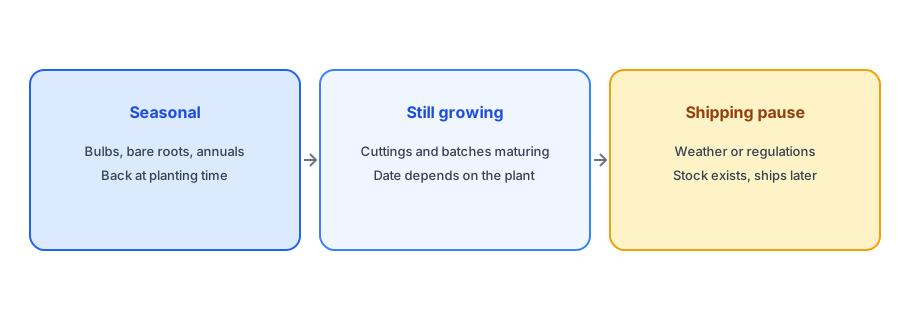
Many plant products are available only part of the year. Bulbs, bare-root trees and seed potatoes have planting windows, annuals sell out when the season peaks and perennials may be dormant and unavailable to dig and ship. A shopper who finds a sold-out bulb in spring may be waiting until autumn. Be clear about that on the page, and use the signup to build a list for the next season. A line such as "Available again for autumn planting" tells the shopper whether waiting makes sense. If you cannot say when, say so, as discussed in our guide to showing an estimated restock date.
Batches Grow on Their Own Clock
Propagated plants such as cuttings, grafts and tissue-culture stock take time that cannot be hurried, and the pace varies by species and conditions. If you are waiting for a batch to be ready to ship, a firm date may be a guess. A window is more honest, and so is a note that you will update subscribers if it changes. Rare and sought-after varieties often attract long waits and eager buyers, so plan for more subscribers than units. Our posts on limited restocks and waitlists and a fair waitlist for limited units explain how to handle that.
Each Plant May Be Unique
For some products, such as variegated specimens or mature plants, no two items are identical. Sellers list individual plants rather than a generic product, and when one sells, it is gone for good. A restock alert for that listing is meaningless. Distinguish between items that are produced in batches, where an alert makes sense, and one-of-a-kind specimens, where it does not. For the latter, you might invite shoppers to sign up for new arrivals instead, though that is a different kind of email from a restock alert and needs its own consent. Our post on alerts for jewelry stores discusses a similar split between one-offs and repeatable pieces.
Tell plant lovers when their variety is back. Griffin adds Notify Me to each sold-out variant and is free to start.
Install Griffin on ShopifyShipping Pauses Are Not Stockouts
Live plants do not tolerate extreme heat or cold in transit, so many sellers pause shipping in bad weather, and some regions restrict shipping of certain plants. In those cases you may have stock but cannot sell it. How you handle that in Shopify depends on your setup. If you set quantity to zero to stop orders, the product shows as sold out and restock alerts will fire when you set it back, which can send subscribers an email for something that ships only after a delay. Say so in the email: "Back in stock and shipping from Monday." If you use other methods to pause sales, check how they affect inventory counts and alerts. Our guide to false back-in-stock alerts explains how mismatches arise.
Variants: Pot Sizes and Packs
Plants come in pot sizes, bare-root versus potted and multi-packs, and each is a variant with its own stock. A shopper waiting for a large pot does not want an email about a small one. Griffin ties each signup to the variant the shopper chose and notifies only that variant's subscribers when it returns. Check that the form updates when the shopper switches size; see why the button can disappear on a variant switch.
Using Signups to Plan Propagation and Orders
For a grower, signups are a planning tool: a variety with a long list is a candidate for more cuttings or a larger order from the supplier. Look at lists before the season, not after, and treat small counts as hints, since plants take time and a miscalculation costs a season. Our guide to tracking customer demand for out-of-stock products shows how to read the data, and the seasonal inventory planner helps you turn it into quantities.
A Practical Checklist
- Add Notify Me to every pot size and pack that can sell out.
- Say whether a stockout is seasonal, a growing batch or a shipping pause.
- Give a window rather than a date for batches that are still growing.
- Do not offer a restock alert for true one-of-a-kind specimens.
- Tell subscribers when stock exists but shipping starts later.
- Use signup counts before the season to plan propagation.
FAQ
Why are restock alerts different for plant stores?
Because plants are seasonal, grow in batches and cannot always ship, so the reason for a stockout varies and the alert should say which.
Should I offer Notify Me on one-of-a-kind plants?
No. If the specific plant will not return, a restock alert promises something you cannot deliver.
What if I pause shipping because of weather?
Say so in the restock email, including when shipping resumes, so subscribers know what to expect.
Do pot sizes need separate alerts?
Yes. Each size is a variant with its own stock, and subscribers should hear only about the one they chose.
The Bottom Line
For plants, an honest restock alert explains why the item was unavailable and when it will really ship. Griffin is a Shopify back-in-stock app you can install from the Shopify App Store, free to start.