Peak season is where inventory decisions cost the most. Order too little and your best sellers sell out in the first week, when traffic is highest. Order too much and you finish the season with a pile of stock and a cash hole. The planner below uses numbers you already have: last peak's units, the growth you expect, the stock you hold and your supplier's lead time. It returns an order quantity, the cash it ties up, the latest date to order and what you would be left with if growth does not arrive. If you are working on seasonal inventory planning on Shopify, it is a way to turn a guess into a range. The values shown are examples.
The Peak Season Planner
How the Planner Works
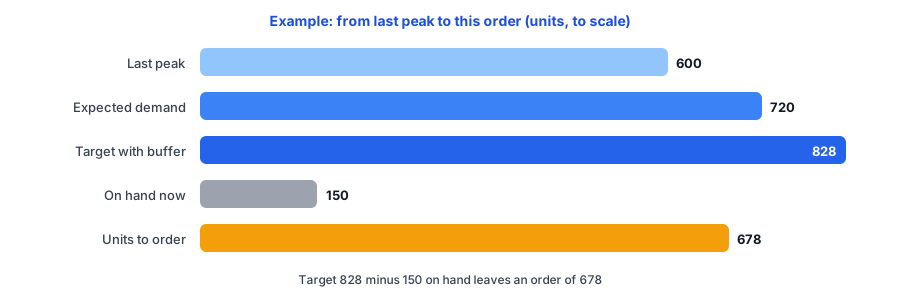
Expected peak demand is last peak's units times one plus your growth. A buffer on top gives your stock target. Subtract the units on hand and on order and what remains is the order. In the example, 600 units at 20 percent growth is 720. A 15 percent buffer makes 828, and with 150 on hand the order is 678. At 14 a unit, that is 9,492 of cash.
The second half answers the question that matters more: what if you are wrong? If the peak is only flat on last year, the order above leaves 228 units unsold, which is the stock and cash you would carry into the new year. Run the planner at zero growth and at your hoped-for growth, and order somewhere you can live with at both ends.
Picking the Growth Number Honestly
- Look at last peak against the one before it, if you have both.
- Count only growth you can explain: a bigger email list, new ad budget or a new channel.
- Use units, not revenue, so price changes do not distort the figure.
- Remember last peak's units may have been capped by a stockout. If so, true demand was higher; the lost-sales calculator helps you estimate by how much.
Order in Stages When You Can
If your supplier allows it, place part of the order now and hold the rest until early sales show how the peak is going. That needs a short lead time and a reliable supplier, so check both. The reorder point and safety stock calculator turns your lead time into a trigger, and the days of inventory left calculator shows when stock will run out once sales start. Before a big sale, decide how many units to hold back for full-price sales with the stock allocation calculator.
Plan for the Sell-Out Too
Even a good plan can fall short of a very good peak. That is where Griffin, a Shopify back-in-stock app, helps: it adds a Notify Me popup or inline form to sold-out products. Shoppers sign up for the variant they want, and Griffin emails them when stock returns. Signups are stored in Griffin's own records, and the free plan includes 100 notifications a month. Waiting lists from this peak are also evidence for next year's plan; our guide to tracking demand on out-of-stock products shows how to read them. Griffin does not forecast demand. The holiday readiness audit covers the rest of your preparation.
If the peak beats your plan, the sold-out page should still capture the demand. Griffin adds Notify Me to sold-out variants.
Install Griffin on ShopifyFAQ
How much stock do I need for peak season?
A practical starting point is last peak's units sold, adjusted for the growth you honestly expect, plus a safety buffer, minus the stock you already have or have on order. Then check what that costs and what you would be left with if the peak is flat.
How far ahead should I order for peak season?
At least your supplier's lead time before the peak starts, plus time for delays and for stock to be received and checked in. Sources advise planning early in general terms, so treat the order-by date as the latest date, not a target.
What growth rate should I assume?
Use your own evidence: how the last peak compared with the one before, how your audience has grown and what you plan to spend on marketing. Run the calculator at flat and at your hoped-for growth to see the range of outcomes.
Does Griffin forecast seasonal demand?
No. Griffin captures restock signups on sold-out products and variants and emails those shoppers when the item returns. It does not forecast demand, but waiting lists show demand you could not serve in a past peak.
The Bottom Line
A peak season order is a bet, so size it with the downside in view. Start from last peak's units, state your growth assumption, check the cash and the leftover stock and order by the date your lead time requires. Griffin is a Shopify back-in-stock app you can install from the Shopify App Store, free to start.