Turnover tells you how fast stock sells and the ABC analysis tells you which products bring in the most revenue. Neither answers a question that matters just as much: which products earn the most profit for the money you have tied up in them? That is what GMROI, gross margin return on inventory investment, measures. A fast seller with thin margins and a slower one with fat margins can look very different on GMROI than on either of the other numbers. Paste your products below and the tool ranks them, flags those that earn little for the stock they hold, and shows your overall figure. If you wanted a GMROI calculator for a Shopify store, this is it. The products and numbers shown are examples.
The GMROI Tool
The Formula, Step by Step
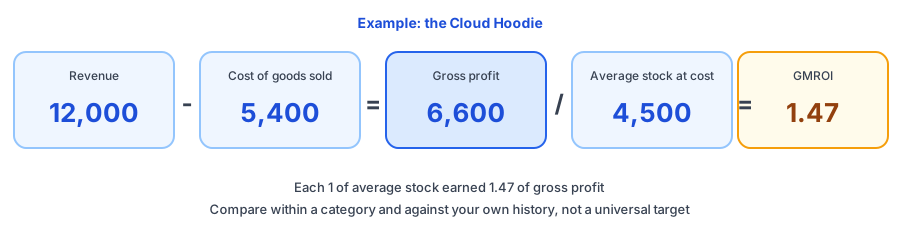
Shopify's GMROI guide gives the formula as gross profit divided by average inventory cost, with gross profit as revenue minus cost of goods sold. In the example, the Cloud Hoodie brings in 12,000 and costs 5,400 to make or buy, so gross profit is 6,600. You held an average of 4,500 of it, so GMROI is about 1.47: each 1 of stock earned 1.47 of gross profit.
Average inventory matters. The same guide averages inventory cost over several points in the period, such as the start of each month, because a single closing figure can mislead if stock swings. Enter the average, not the last number you looked at.
Reading the Ranking
In the example, the Everyday Tee earns about 3.19 and the hoodie about 1.47, while the Canvas Tote, Wool Beanie and Enamel Pin Set earn less than 1. The tote ranks third on revenue, but it holds a lot of stock for what it earns. Revenue alone would have kept it near the top; GMROI shows it is tying up money. Compare the ranking with ABC analysis, and with inventory turnover, which shows speed without profit.
No Universal Good Number
Shopify's guide says GMROI should be compared against similar categories, not a single retail target, and suggests comparing by store, category, SKU or variant and against your own history. Sources also define gross profit slightly differently, with some subtracting more costs than cost of goods sold, so state your definition and keep it fixed. Resist copying a benchmark from an article. Your threshold is whatever return you need on stock after your other costs; the inventory carrying cost calculator helps you set it, since a GMROI that is lower than your carrying cost per 1 of stock (24 percent is 0.24) means the stock is not even covering the cost of holding it.
What to Do With Low Performers
- Check whether the stock is too high, the margin too thin or both. A tote with high stock needs smaller orders; a low-margin item may need a price rise.
- Look for dead stock before you cut: the dead stock clearance planner sets a markdown floor.
- Do not cut stock on items with waiting lists. A sold-out product may show little revenue and still have strong demand.
- Revisit each quarter, and add it to your weekly inventory check.
Where Griffin Fits
Griffin does not calculate profit, but it covers a blind spot in any return-on-stock ranking: products that are out of stock show no sales, so they can look like poor performers when they are not. Griffin, a Shopify back-in-stock app, adds a Notify Me popup or inline form to sold-out products, and shoppers sign up for the variant they want. Signups are recorded per product and variant, so you can see demand that sales cannot show; our guide to tracking demand on out-of-stock products explains how. The free plan includes 100 notifications a month.
A sold-out product can look like a poor performer. Griffin shows the demand behind it through restock signups.
Install Griffin on ShopifyFAQ
What is GMROI?
GMROI, or gross margin return on inventory investment, is gross profit divided by average inventory cost. It tells you how much gross profit each unit of money tied up in stock earns.
How do I calculate GMROI?
Subtract cost of goods sold from revenue to get gross profit, then divide by your average inventory at cost. Average inventory is the average of your inventory cost over several points in the period, not just the end.
What is a good GMROI?
There is no universal target. Shopify says to compare GMROI against similar categories and your own history. A value above 1 means you earn more than 1 of gross profit for each 1 of average stock, but whether that is enough depends on your other costs.
Does Griffin calculate GMROI?
No. Griffin captures restock signups on sold-out products and variants and emails those shoppers when the item is back. It does not calculate profit or inventory returns.
The Bottom Line
GMROI asks what each unit of money in stock earns. Rank your products by it, look hard at those below your threshold and check for waiting demand before you cut. Griffin is a Shopify back-in-stock app you can install from the Shopify App Store, free to start.