Slow stock does not feel expensive, because nothing is leaving your account each month. But it is. The money is tied up, the shelf space is not free, and the longer a box sits the more likely it is to be damaged, to go out of date or to lose value. Adding those costs up gives your inventory carrying cost, the yearly price of holding stock. The calculator below takes your own cost components, returns the total in money and as a percentage of the value you hold, and prices the stock that is not moving. If you wanted an inventory carrying cost calculator for a Shopify store, enter your numbers and read the result. The values shown are examples.
The Carrying Cost Calculator
The Formula and the Parts
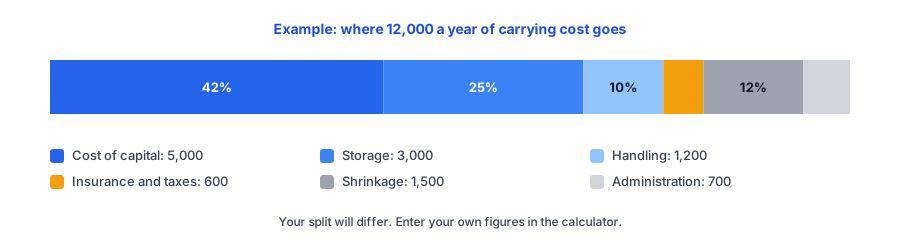
Shopify's guide to inventory carrying costs gives the formula as the holding sum divided by total inventory value, times 100, where the holding sum is every holding cost added up over a period, usually a year. Other sources divide by average inventory value instead, which is why the calculator asks for an average. Either way, the answer is the percentage of your stock's value that it costs you to keep it for a year. In the example, 12,000 of costs on 50,000 of stock is 24 percent.
Shopify lists the parts as the cost of capital, storage and warehousing, handling, insurance and taxes, depreciation, spoilage and shrinkage, and administration. For a Shopify store the least obvious one is capital: money in stock could have paid down debt, funded ads or sat in the bank, and that has a cost even when no invoice arrives.
Do Not Borrow a Benchmark
You will see a typical range quoted for carrying costs. Treat it with caution: sources say there is no agreed benchmark, and Shopify's own percentage is a worked example for a made-up store. Your number depends on your products, your storage and your cost of money. A better use of the result is to track it over time and to compare product groups, such as light and heavy goods, or items that expire and items that do not.
What to Do With the Number
- Price the slow stock. The last result shows what your slowest items cost to keep. Compare it with what clearing them would realistically recover; the dead stock clearance planner helps you set a floor.
- Find the slow items first. Use the ABC analysis tool and check inventory turnover.
- Use it as the holding cost in the economic order quantity calculator to size orders.
- Weigh it against stockouts. Holding less saves money but risks missed sales, so check the lost-sales calculator before you cut deeply.
Where Griffin Fits
Carrying costs push you to hold less, and holding less means more sold-out products. Griffin, a Shopify back-in-stock app, adds a Notify Me popup or inline form to sold-out products so the demand you cannot serve is not lost: shoppers sign up for the variant they want, and Griffin emails them when it is back. Signups are recorded per product and variant, which shows where holding a little more is worth it; see tracking demand on out-of-stock products. The free plan includes 100 notifications a month. Griffin does not manage stock levels or calculate carrying costs.
Hold less stock without losing the shoppers who wanted it. Griffin captures signups on sold-out variants.
Install Griffin on ShopifyFAQ
What is inventory carrying cost?
It is the total yearly cost of holding stock: the money tied up, storage and warehousing, handling, insurance and taxes, and the losses from stock that spoils, shrinks, goes out of date or has to be written off.
How do I calculate carrying cost as a percentage?
Add up all your holding costs for the year, divide by your inventory value and multiply by 100. Sources differ on whether to use total or average inventory value, so pick one and use it every time.
What is a good inventory carrying cost percentage?
There is no universal figure. It depends on your products, your storage, your cost of money and how fast things go out of date, so compare your own result over time and across product groups instead of with a headline number.
Does Griffin reduce carrying costs?
No. Griffin captures restock signups on sold-out products and variants and emails those shoppers when the item is back. It does not manage stock levels, though a waiting list can show which sold-out products justify holding more.
The Bottom Line
Stock has a yearly price, and it is usually higher than it feels. Add up your own costs, express them as a share of value and use the result to decide what to clear, what to hold and how much to order. Griffin is a Shopify back-in-stock app you can install from the Shopify App Store, free to start.