The reorder point tells you when to order. It does not tell you how much. Order small and often and you pay for every order and every shipment; order in huge batches and cash sits on the shelf. The economic order quantity, or EOQ, is the classic way to find the balance between the two. The calculator below turns your yearly demand, the cost of placing an order and the cost of holding a unit into an order size, shows how many orders that means each year and compares it with the order size you use today. If you want to work out your economic order quantity in a minute, enter your numbers. The values shown are examples.
The EOQ Calculator
The Formula, Step by Step
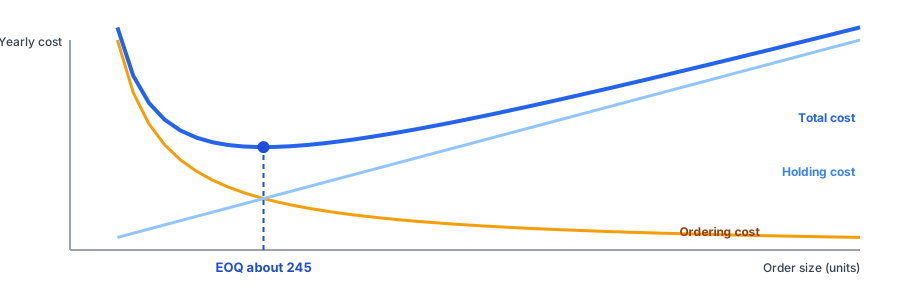
Shopify's EOQ guide gives the formula as the square root of 2DS divided by H, where D is annual demand, S is the cost of one order and H is the holding cost per unit. In the example, 2,400 units a year, 50 per order and a holding cost of 4 per unit (20 percent of a unit cost of 20) give the square root of 60,000, about 245 units. That is roughly 9.8 orders a year, one every 37 days, and ordering and holding each cost about 490, for a total near 980.
The comparison is the useful part. Ordering 600 at a time means fewer orders but far more stock on the shelf, and the example costs about 1,400 a year. The curve around the EOQ is flat, so a little off the exact number costs very little. A big miss costs much more.
What the Formula Assumes
- Steady demand. Shopify's guide notes that EOQ assumes constant demand, which makes seasonality and changing demand hard to handle. For peak planning, use the seasonal inventory planner.
- A known, steady lead time, and no discounts for ordering more.
- Costs that stay fixed: the cost per order, and the cost to hold a unit.
Real suppliers add minimums and price breaks. If your minimum is higher than the EOQ, enter it in the calculator to see what it costs you, and if the gap is large, our supplier email templates include a request to negotiate it.
Putting EOQ Together With the Reorder Point
The two answers work as a pair. EOQ says how much to order, and the reorder point says when. The reorder point and safety stock calculator sets the trigger from your lead time, and the days of inventory left calculator tells you how long each order will last. Your holding cost depends on what carrying stock really costs you, which our inventory carrying cost calculator helps you work out. For a new product with no history, use the first-run quantity calculator instead.
Where Griffin Fits
Griffin, a Shopify back-in-stock app, does not decide order sizes. What it does is capture demand while you are between orders: a Notify Me popup or inline form on sold-out products lets shoppers sign up for the variant they want, and Griffin emails them when it is back. Signups are stored in Griffin's own records, and the free plan includes 100 notifications a month. A long waiting list is a sign that your orders are too small or too late, and the waitlist-to-order calculator turns it into a quantity.
Between orders, sold-out products should still collect demand. Griffin adds Notify Me to your sold-out variants.
Install Griffin on ShopifyFAQ
What is economic order quantity?
It is the order size that minimizes the combined yearly cost of placing orders and holding stock. Order too often and ordering costs add up; order too much and holding costs do.
What is the EOQ formula?
EOQ is the square root of (2 x annual demand x cost per order, divided by holding cost per unit per year). The calculator above shows each step.
When does EOQ not work well?
It assumes steady demand, a known lead time and no bulk discounts. Seasonal or fast-changing demand, supplier minimums and price breaks all make the raw number less reliable, so treat it as a starting point.
Does Griffin calculate order quantities?
No. Griffin captures restock signups on sold-out products and variants and emails those shoppers when the item is back. It does not forecast demand or advise on how much to order.
The Bottom Line
EOQ gives you a defensible order size and shows what a different one costs. Use it as a starting point, adjust for minimums and seasons, and pair it with a reorder point. Griffin is a Shopify back-in-stock app you can install from the Shopify App Store, free to start.