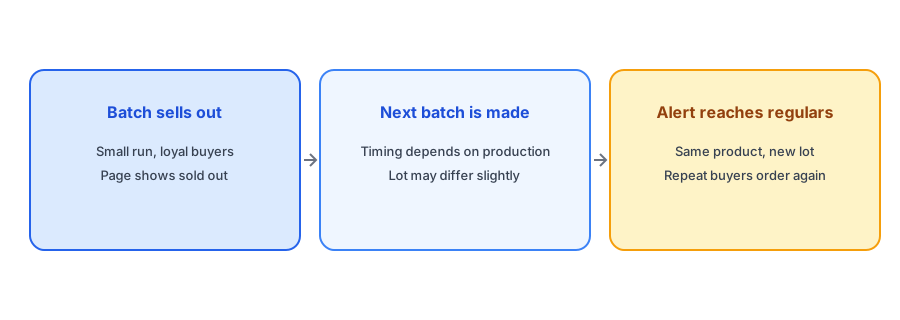
Coffee roasters, tea blenders, hot sauce makers and other specialty food sellers often sell out by design. A small batch, a seasonal flavor or a limited roast is part of the appeal, and the next run is scheduled around production rather than around demand. Back-in-stock alerts have a particular job for food brands: they turn a one-time buyer into a repeat buyer by catching them at the moment they want more. Because consumables are used up and bought again, the alert matters more here than in categories where a customer buys once. This post sticks to how specialty food is made and bought, and does not rely on invented statistics.
Batches, Lots and Honest Descriptions
Unlike a durable good, a food product can change slightly between runs: a different harvest, a new lot, a tweak to the recipe. Regulars notice. When you restock, say whether it is the same product and, where it matters, what is different. A short line such as "this is the new harvest, a little brighter than the last" sets the right expectation and gives your restock email something worth reading. If you cannot be sure the product is identical, do not promise it is.
Seasonal Flavors Create Deadlines
A pumpkin blend or a holiday tea has a window, and shoppers know it. If a seasonal item sells out mid-season, a restock alert is useful for a few weeks and then irrelevant. If it will not return this year, say so rather than leaving people subscribed to a restock that never comes. Those subscribers are also a ready-made list for next season, so be clear about what they are signing up for. Our guide to handling subscribers when a product will not return covers the wording.
Freshness Shapes How You Restock
Food has a shelf life, and many specialty sellers prefer to ship freshly made batches rather than hold stock. That makes lead times honest and sometimes slow. If production runs on a schedule, show it. A line like "next roast ships the first week of the month" helps shoppers decide whether to wait, and it reduces the stream of "is it back yet?" emails you would otherwise answer one by one. Our replies for "when will it be back in stock?" can save you time on the rest.
Catch repeat buyers the moment a batch returns. Griffin adds Notify Me to every sold-out flavor and size.
Install Griffin on ShopifySizes, Grinds and Flavors Are Variants
One product page often hides many variants: a 250 g bag versus 1 kg, whole bean versus ground, mild versus hot. Each has its own stock, and a shopper waiting for the whole-bean bag does not want to hear that the ground version is back. Griffin ties each signup to the variant chosen and notifies only that variant's subscribers when it restocks. Check that the Notify Me option still appears when a shopper switches between variants, since this is a common point of failure; see why the button can disappear when a shopper switches variants.
Alerts and Subscriptions Together
Many food sellers offer a recurring order for regulars. Subscribers and alert signups draw on the same stock, so decide who is served first when a batch is small. Our post on what happens to subscription orders when a product sells out explains the choices.
Using Signups to Plan the Next Batch
For a small producer, the list of people waiting is also a planning tool. A flavor with a long list is a good candidate for a bigger run, while a flavor with a handful of signups may not justify one. Look at which sizes people ask for as well, since a bulk bag and a trial size may have very different demand. This is the same logic described in our guide to tracking customer demand for out-of-stock products, applied to production planning rather than purchasing. Be careful not to over-read a small list: a few signups is a hint, not a forecast, and food that goes unsold has a shelf life that other products do not.
A Practical Checklist
- Add Notify Me to every size, grind and flavor that can sell out.
- Say whether a restock is the same product or a new lot.
- Show your production schedule when you have one.
- Tell seasonal subscribers early if an item will not return this year.
- Decide how subscription orders and alert subscribers share a small batch.
FAQ
Why do specialty food stores need restock alerts?
Because small batches sell out by design and customers buy again. An alert brings repeat buyers back when the next batch is ready.
Should I mention a new lot in the restock email?
Yes, when it matters to the customer. Regulars notice differences, and a short honest note sets the right expectation.
What should I do with alert signups for a seasonal flavor that ended?
Tell them it is not returning this season and, if you plan to bring it back, say when. Do not leave them waiting on an alert that will not come.
Do different sizes and flavors need separate alerts?
Yes. Each is a variant with its own stock, and subscribers should hear only about the one they chose.
The Bottom Line
For specialty food, the restock alert closes the loop between one batch and the next. Be honest about lots and timing, treat each size and flavor as its own product, and tell seasonal subscribers the truth. Griffin is a Shopify back-in-stock app you can install from the Shopify App Store, free to start.